 Title: The Music LoversYear: 1971Country: UKLanguage: English, FrenchGenre: Biography, Music, DramaDirector: Ken Russell Screenwriter: Melvyn BraggBased on the book by Catherine Drinker Bowen and Barbara von Meck Music: André Previn Cinematography: Douglas SlocombeEditor: Michael BradsellCast:Richard ChamberlainGlenda JacksonIzabella Telezynska Christopher GableSabina MaydelleKenneth ColleyMax AdrianMaureen Pryor Andrew FauldsBruce RobinsonRating: 7.8/10English Title: Tchaikovsky's WifeOriginal Title: Zhena ChaikovskogoYear: 2022Country: Russia, France, SwitzerlandLanguage: Russian, French, ItalianGenre: Biography, DramaDirector/Screenwriter: Kirill SerebrennikovMusic: Daniil OrlovCinematography: Vladislav OpelyantsEditor: Yuriy Karikh Cast:Alyona MikhaylovaOdin Lund BironVladimir MishukovFlipp AvdeevNatalya PavlenkovaEkaterina ErmishinaVarvara ShmykovaAlexander Gorchilin Miron FedorovNikita PirozhkovViktor KhorinyakNikita ElenevAndrey BurkovskiyGurgen TsaturyanYuliya AugRating: 7.5/10One story, two disparate approaches. Russian composer Pyotr Ilyich Tchaikovsky (1840-1893) is a household name today, but apparently his personal life was quite a scandal thanks to his closeted homosexuality. The fascinating recount about his lavender marriage (avant la lettre) with Antonina Miliukova (1948-1917) is the subject of the two films, made half a century apart. THE MUSIC LOVERS is one of Russell’s biopics about classical composers, hot on the heels of his breakout with WOMEN IN LOVE (1969). Chamberlain’s Tchaikovsky is handsome, delicate, but over a barrel, exceedingly tormented by anguish and guilt of his sexuality. His elation can only be glanced in the passing merrymaking with his lover Count Anton Chiluvsky (Gable) in the opening festivity (invoking “Hunter in the Snow” by Pieter Bruegel the Elder), or later, when his star is rising and his works gain traction (where Russell’s grandiose creativity juice is flowing most plentifully. “Cannonballs aiming to those who have done him wrong!”). So most of the time Tchaikovsky is a stereotyped sad sack. Intrigued by the billets-doux from Antonina (Jackson), he takes the plunge to wed her hoping for a platonic marriage like a brother and a sister. Only in Russell’s lascivious reverie, Antonina is a nymphomaniac. The couple’s abortive sexual intercourse inside a roomette is a hog-wild nightmare. Never before in a motion picture, a woman’s naked body is presented so unsexy, even repulsive. Jolted by the streaking train, Jackson’s skinny frame in the raw is crimped inside a pokey space, lying like an empty skeleton, inert, defeated, barely breathing. Their marriage is dead on arrival, and in time, it drives one insane and the other suicidal (Tchaikovsky is haunted by the horrific death of his mother, mistreated after catching cholera, and it becomes his death wish). After that, a separation is propounded and implemented, and Antonina behaves increasingly erratic, neurotic and voracious in carnal knowledge with other men. Meantime Pyotr finds refuge in his patron Madame Nadezhda von Meck (Telezynska). If anything, their relation exemplifies what Pyotr wants with a woman: distant (Madame von Meck doesn’t want to meet her beneficiary in person), chaste (the only time they lay on the same bed, no body contact is performed) and idolatrous (she is the No. 1 fan of his music). Nonetheless, his secret is the deal breaker for her, not enough soul-ensorcelling music in the world can redeem his “perversion”. In accordance with Russell’s overblown disposition, THE MUSIC LOVERS can be best described a careening roller coaster, rhapsodically heading towards disasters and destruction like nobody’s business. Chamberlain and Jackson make for a compelling duo sharing a folie à deux, perfect attuned to Russell’s masochistic expressions of delusion and derangement, plus with London Symphony Orchestra, conducted by Previn, performing Tchaikovsky’s centerpieces, the film can sweep audiences off their feet far and away. Russian director Kirill Serebrennikov’s angle towards the same subject is to put Antonina (Mikhaylova) in the dead center, who is in almost every scene, and unfurl the narrative exclusively from her point of view. Serebrennikov, a devout dissenter towards Russia’s conservative ethos, has established his names both on theater and cinema. TCHAIKOVSKY’S WIFE is his tenth feature and it is such a beaut in hue, blending old sepia with a divine coldness of dun, taupe, glaucous, often facilitated by natural lighting, and it goes without saying, the film is far more historically accurate in the settings and the mood. In the beginning, Antonina is just a pious girl who carries a torch for Tchaikovsky (Biron), and when the latter first refuses, then agrees to her bold proposition, she credits it to the omnipotent God. But when it is apodictic that they cannot consummate their marriage, and she is a fish out of water among Pyotr’s homosocial circles, Antonina turns into an erotomaniac and a religious fanatic subservience to her vain and hubris of being the wife of a genius. There is the moment where Antonina is explicitly informed by Pyotr’s sister Sasha (Shmykova) of his condition, still, she believes she could make him love her. Refusing to divorce Tchaikovsky - a way out sounds rather reasonable to any victims unwittingly marrying a gay man - Antonina is shunned by Tchaikovsky, ghettoized and ridiculed by his associates. Driven by her quixotic idée fixe, her sanity starts to crack. She shackles up with her lawyer Shlykov (Mishukov), who is abusive, and gives birth to 3 children (all end up in the orphanage). The last straw is the tidings of Tchaikovsky’s death, which bookends the film. It is a mercy that Serebrennikov doesn’t protract the story to Antonina’s asylum years. In the final moment, her disintegration is masterfully choreographed by a slithering long take where she is bedeviled by naked,, virile men dancing around her, lifting her up and down, symbolizing her escapable trials and tribulations, for which a self-serving Pyotr is inexcusably responsible, but her own benightedness is equally culpable, if not more. For that regard, Serebrennikov’s astuteness is clear as day. Also memorable is the beguiling temporal shift scenes set in a spatially static set (a train station, a room), which bear out that Serebrennikov’s superb directorial flair finally comes into its own. In the center stage, Mikhaylova, with her demure miens and supple physicality, gives a deeply affecting account of herself as a lone warrior fighting a lost cause. A stoical heroine spurred by a single-minded blind faith, although such contrivance often rouses suspicion of seeking martyrdom. Biron, playing the second fiddle with that delicate air of revulsion and dread whenever Tchaikovsky is blind-sided by Antonina, also manifests a different look in Antonina’s illusory, snowbound dreams, a loving and successful father and husband, but his speaking expression betrays the dubiety. Both players hit their marks with flying colors. On a lesser note, a cameo by Yuliya Aug, who plays an unkempt fruitcake accosting Antonina in front of the church, causes a lasting impression as a disconcerting premonition of Antonina’s own future. A final note, regretfully, both film refrain from any graphic scenes depicting Tchaikovsky’s homosexual behaviors. THE MUSIC LOVERS may be hogtied by its time (it is the same year of John Schlesinger’s SUNDAY BLOODY SUNDAY, also starring Jackson, where a scene of two men kissing is a tub-thumbing provocation), yet if anyone would’ve done it, Ken Russell seems to be the right one. But is it still too big a taboo to stare the verity in its eye today? TCHAIKOVSKY’S WIFE can smartly dodge that by changing its focal point to Antonina. For all his soul-consuming, guilt-ridden inner demon, Tchaikovsky must have some blissful days when he can simply be himself with reservation and disguise among the right persons, that is what a filmmaker owes to a genius like him if a biopic of him is greenlit. Someone please dig up something worth telling about Antonina’s husband, his side of truth is also of import. referential entries: Ken Russell’s WOMEN IN LOVE (1969, 8.4/10), THE DEVILS (1971, 7.7/10); Kantemir Balagov’s BEANPOLE (2019, 7.4/10); Andrey Zvyagintsev’s LEVIATHAN (2014, 7.7/10).


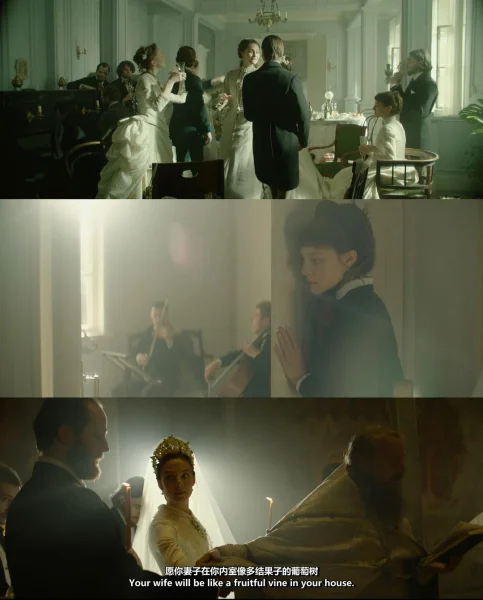 故事发生在19世纪末的俄罗斯,一个女性只是男性护照上名字的时代。安东尼娜对柴可夫斯基一见钟情,一心要成为他的妻子,她用金钱交换一个名分。柴可夫斯基为了躲避留言同意了这场婚事,但之后就是漫长的折磨。安东尼娜嫁给了自己臆想的婚姻,柴可夫斯基则承受不了生活的喧哗与琐碎一心要远离安东尼娜去创作。安东尼娜的偏执让她不断追着男人的脚步走,不承认大家都了解的他的性向,不承认他不爱她,不签署关于丈夫的任何指控,即使她找不到他也已经和律师组建了新的家庭和孩子,也依然手握“柴可夫斯基的妻子”的身份,直至柴可夫斯基功成名因瘟疫去世……


